
ActiveCampaign or HubSpot? The Better Option for Your Marketing Team
ActiveCampaign and HubSpot are both excellent but built for different jobs. Here’s how to know which one is right for your team in 2026.
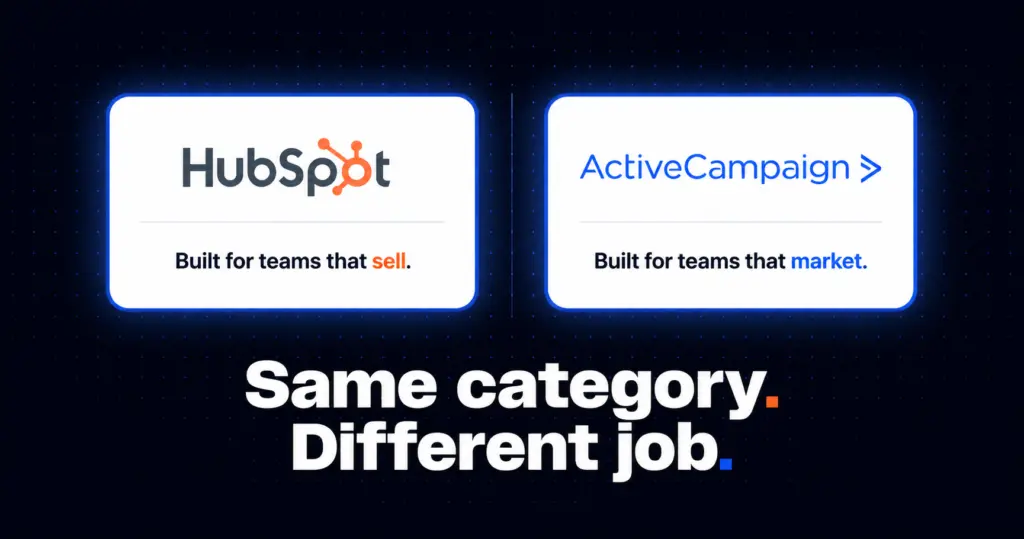
HubSpot and ActiveCampaign appear in the same category on every software review site. They share feature names (automation, CRM, email, segmentation, AI), and they serve some of the same customers. But they were built around fundamentally different beliefs about what marketing software should do, and those beliefs show up in every part of how the platforms work.
Getting this decision right significantly changes how your team operates. Switching costs , including data migration, team retraining, and workflow rebuilding, average $15,000–$40,000. The goal here is to help you choose correctly the first time.
The Core Difference between ActiveCampaign and HubSpot
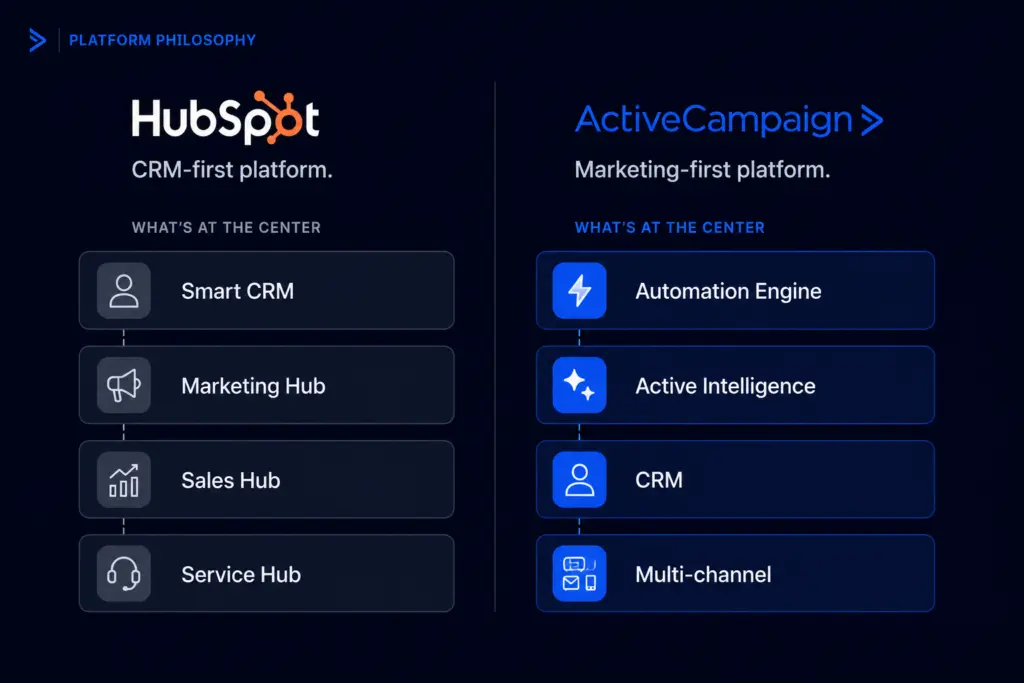
ActiveCampaign is built for marketers who think in workflows. Its automation builder is the core product; everything else orbits around it. HubSpot is a business operating system that happens to include email marketing. The Smart CRM sits at the center, with Marketing Hub, Sales Hub, Service Hub, and Content Hub radiating outward.
If your company’s primary motion is sales-led, say, pipeline management, lead assignment, multi-team visibility, CRM as the single source of truth, HubSpot was built for the problems you have. It is genuinely excellent at unifying data across marketing, sales, and service so that everyone is working from the same picture of each customer.
If your company’s primary motion is marketing-led, say, campaigns, behavioral sequences, personalization at scale, email as a core revenue channel, ActiveCampaign was built for the problems you have. Its entire architecture is oriented around executing marketing, not just recording it.
Don’t make the mistake of buying the platform that sounds more impressive rather than the one that matches how their business actually grows.
Where HubSpot Shines
1. Multi-team alignment.
HubSpot’s biggest genuine strength is what happens when marketing, sales, and service are all working inside the same platform. Lead handoffs are seamless. Pipeline visibility is shared. Customer data flows between teams without manual syncing or integration maintenance. HubSpot prioritizes CRM infrastructure: pipelines, records, cross-team visibility. For companies where that alignment is the problem, HubSpot is the right answer.
2. Reporting and analytics.
HubSpot includes custom reports, interactive dashboards, customer journey analytics, and multi-touch revenue attribution. For teams that need to show marketing’s contribution to revenue across the full funnel, from first touch to closed deal, HubSpot’s reporting depth is a genuine advantage.
3. Ease of use.
HubSpot’s interface is polished and intuitive. G2 reviewers consistently praise its user-friendliness, with many noting its intuitive interface and drag-and-drop builder allows users to create engaging emails and landing pages without extensive technical skills. For teams where ease of adoption matters as much as capability, this is a real differentiator.
4. Breadth of the ecosystem.
HubSpot offers unique marketing features including AI search optimization, content remix, ad management, social media management, websites, SEO, shared messaging inbox, and more along with customer service, commerce, and data management capabilities. If you genuinely need all of those things under one roof, HubSpot delivers.
Where ActiveCampaign Wins
1. Email automation depth.
ActiveCampaign’s automation builder is the most sophisticated in its class at this price point. Workflows can be triggered by 45 different signals, including engagement, behavioral activity, purchases, and custom events, then shaped using more than 50 responsive actions and advanced multi-step logic. For teams building complex, behavior-driven sequences, the gap in capability is meaningful.
2. Deliverability.
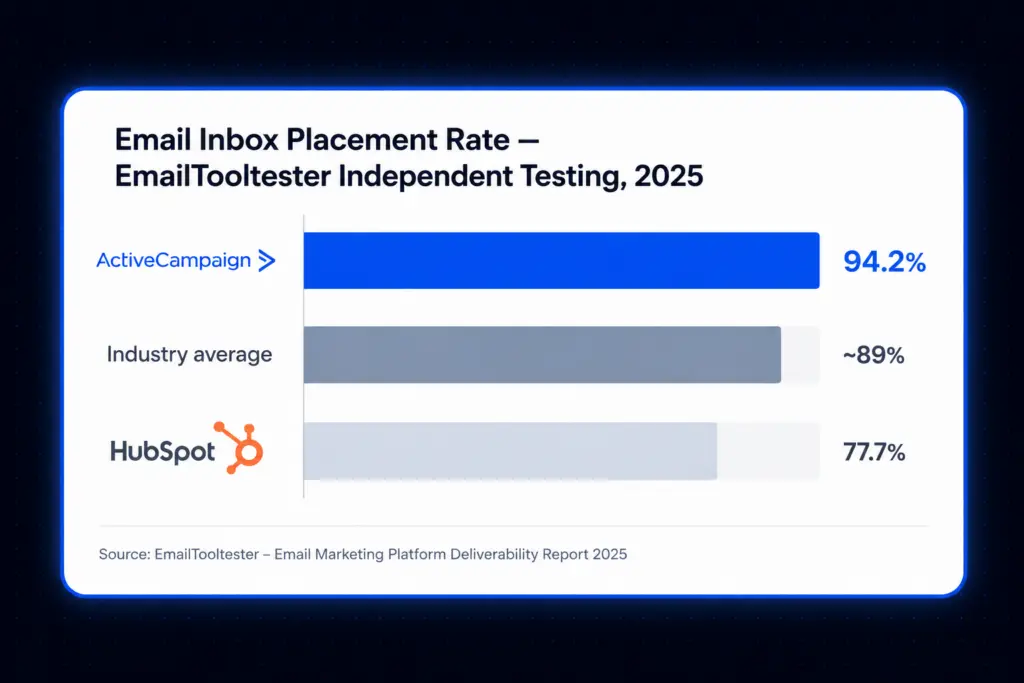
This is the most concrete data point in the comparison and the one that matters most for teams where email is a core revenue channel. According to independent tests by EmailTooltester, ActiveCampaign has an inbox placement rate of 94.2%, making it the market leader across all solutions. HubSpot stands at 77.7% 12th out of 16 tools tested.
Deliverability is worth pausing on. Every other metric open rates, click rates, conversion rates depends on whether the email reached the inbox in the first place. ActiveCampaign invests heavily in list hygiene, authentication configured at onboarding, strict IP reputation management, and BotSense filtering that excludes bot clicks from statistics.
3. Personalization at scale.
ActiveCampaign’s AI agents make it easy to change the content of an email based on tags, custom fields, or customer behavior automating a level of one-to-one personalization that is harder to achieve in HubSpot. For teams running high-volume campaigns across segmented audiences, this capability compounds significantly over time.
5. Active Intelligence.
ActiveCampaign’s AI layer, Active Intelligence, is built specifically for marketing execution. It powers predictive sending that optimizes delivery times per individual contact, AI-suggested segments that surface high-value audiences automatically, and an AI campaign builder that generates complete campaigns from a plain-language description. The result is a platform that doesn’t just execute marketing; it helps determine what marketing should happen next.
See Active Intelligence in action — free 14-day trial →
Who Should Use ActiveCampaign
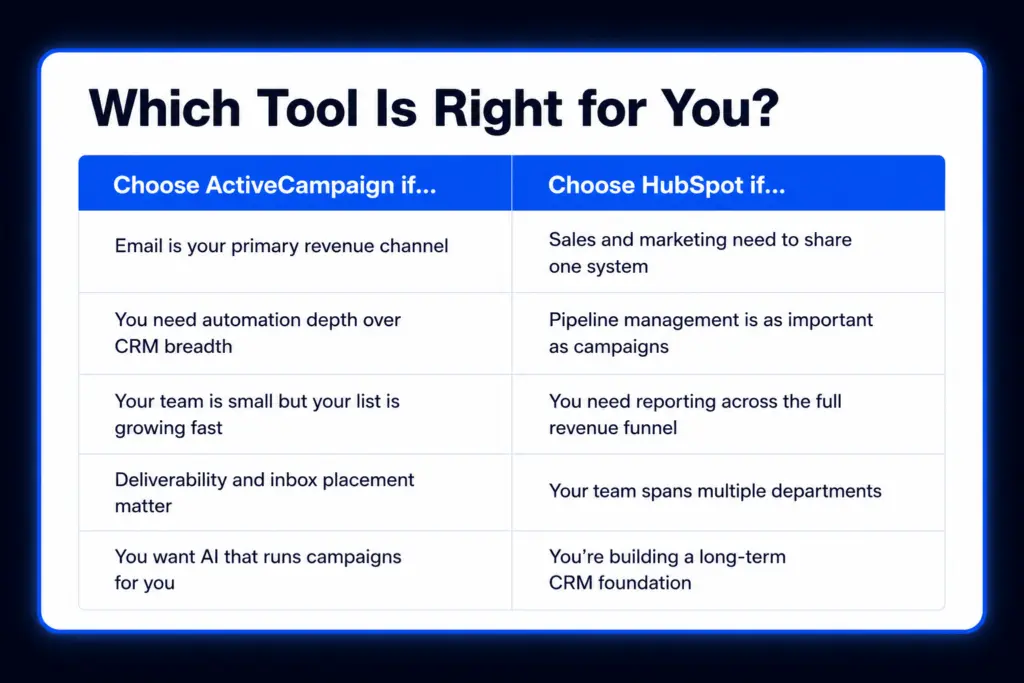
A. Marketing-led growth companies. If email and automated campaigns are your primary revenue-generating motion, you need a platform where those capabilities are the core product, not a module bolted onto a CRM.
B. Teams prioritizing deliverability. If you send high volumes of campaigns, promotional emails, or behavioral sequences and you need them to actually reach inboxes, ActiveCampaign’s independent #1 deliverability ranking is a structural advantage that compounds with every send.
C. Small marketing teams at growing companies. ActiveCampaign’s user base reflects its positioning: Most G2 reviews come from small businesses. The platform is built to give smaller teams enterprise-level automation capability without requiring a dedicated marketing operations person to maintain it.
D. E-commerce businesses. Abandoned cart sequences, post-purchase flows, win-back campaigns, product-specific behavioral triggers, ActiveCampaign’s automation engine is built for exactly this kind of high-volume, behavior-driven marketing.
E. Teams adopting autonomous marketing. If you want a platform where AI handles the execution, building campaigns, finding segments, optimizing send times, monitoring goal progress, Active Intelligence is the most complete implementation of autonomous marketing available at this price point.
Who Should Use HubSpot
A. Sales-led companies with complex pipelines. If your growth depends on a structured sales process, lead assignment, pipeline stages, deal forecasting, sales team visibility, HubSpot’s CRM infrastructure is genuinely hard to match.
B. Companies that need marketing and sales aligned. If your marketing team’s primary job is generating and handing off qualified leads to a sales team, HubSpot’s shared data model makes that handoff seamless in ways that a standalone marketing tool cannot replicate.
C. Larger teams needing full-suite coverage. HubSpot functions as a comprehensive business growth platform that unifies marketing, sales, and customer service operations — the all-in-one approach eliminates the need for multiple tool integrations. For companies where consolidation across departments is the goal, HubSpot delivers.
D. Teams where ease of adoption is critical. If your platform will be used by people across different functions, sales reps, marketers, service agents, HubSpot’s interface makes cross-functional adoption easier than most alternatives.
Frequently Asked Questions
Is ActiveCampaign better than HubSpot?
Neither platform is categorically better, they solve different problems. ActiveCampaign is better for teams where email marketing automation is the primary job. HubSpot is better for teams that need marketing, sales, and service unified in a single CRM-centric platform. The right answer depends on how your business grows.
Which is easier to use: ActiveCampaign or HubSpot?
HubSpot generally has a shallower learning curve for new users. G2 reviewers consistently praise HubSpot’s intuitive interface, particularly for users without extensive technical backgrounds. ActiveCampaign has a steeper initial curve because its automation capabilities are deeper but users who invest in learning it report significantly more powerful results from their campaigns.
What is ActiveCampaign’s Active Intelligence?
Active Intelligence is the AI layer built into the entire ActiveCampaign platform. It powers the AI Campaign Builder, Predictive Sending, AI-Suggested Segments, Predictive Content, and Business Goals, the tools that make autonomous marketing execution possible for small teams at growing companies.
Can I migrate from HubSpot to ActiveCampaign?
Yes. ActiveCampaign offers free migration services and a dedicated onboarding team on all paid plans. The migration process covers contacts, lists, and automation logic. The more complex the HubSpot CRM setup, custom objects, cross-hub workflows, sales pipeline integrations, the more carefully the migration needs to be planned.
What is autonomous marketing and how does ActiveCampaign use it?
Autonomous marketing is where AI agents build, execute, and optimize campaigns based on goals you define, rather than waiting for a marketer to configure each step manually. ActiveCampaign’s Active Intelligence is the most complete implementation of this available to small marketing teams.
Is ActiveCampaign good for B2B marketing?
Yes, particularly for B2B companies where email and automated nurture sequences are central to the pipeline. ActiveCampaign’s automation builder supports complex, multi-step workflows with advanced segmentation, CRM integration, and lead scoring making it well-suited for B2B lead nurturing and lifecycle marketing.
How does pricing compare?
ActiveCampaign starts at $15/month and scales based on contact volume and feature tier. HubSpot offers a free CRM tier, but Marketing Hub Professional, where the most powerful automation and AI features live starts at $800/month for three seats. The right comparison isn’t the entry price but the price at the feature level your team actually needs.
TL;DR
HubSpot and ActiveCampaign are both excellent platforms. The teams that get the most out of each of them are the ones that accurately diagnosed what their marketing operation actually needed.
If your growth runs through email campaigns, behavioral sequences, and personalized journeys at scale, ActiveCampaign’s Active Intelligence gives you a marketing engine that was built to do exactly that, with the deliverability infrastructure and automation depth to back it up.
If your growth runs through a sales team that needs marketing, service, and CRM unified, HubSpot gives you the infrastructure to make that happen.
The Swiss Army Knife is a great tool. So is the chef’s knife. The question is what you’re actually trying to cut.
Ready to see what ActiveCampaign does for your marketing?