
Deel Review: 6 Things I Wish I Knew Before Signing Up
This Deel review covers 6 months of real use across 4 countries — EOR, Global Payroll, and contractor tools. Honest pros, cons, and pricing breakdown.
This Deel review isn’t based on a demo or a pricing page skim. It’s six months of actual use — four countries, a mix of full-time EOR employees and contractors, real payroll runs, and real problems. If you’re deciding whether Deel is worth it, here’s the honest version.
What Is Deel, Actually?
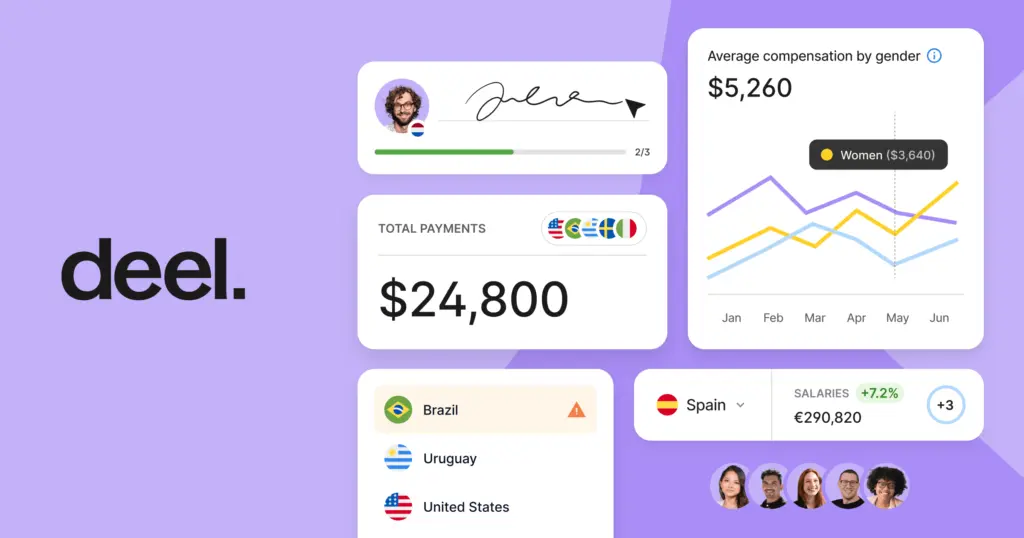
Before the Deel review gets into specifics: Deel is not QuickBooks or Gusto. It doesn’t make local payroll faster. What it does is give you infrastructure to employ and pay people in countries where you have no legal entity — without walking into a compliance disaster.
Three core products:
- Employer of Record (EOR) — hire full-time employees abroad without a local subsidiary
- Global Payroll — consolidate payroll across countries where you do have entities
- Contractor Management — onboard, contract, and pay international freelancers
I’ve used all three with real people’s salaries on the line. Here’s what each one looks like in practice.
To give it a try, you can sign up for Deel using this affiliate link.
Deel Review: Employer of Record — The Part That Kept Me Up at Night
The EOR product is Deel’s flagship, and it’s genuinely the most impressive thing they do.
My situation: I’d found a software engineer in Lagos I wanted to hire urgently. No Nigerian entity, no subsidiary, nothing. My options were spend months setting one up, quietly pay him as a contractor and hope nobody looked too closely, or don’t hire him at all. None of those were good options.
Deel’s EOR was the fourth option. They act as the legal employer in Nigeria through their own local entity. He works for me on my projects, in my Slack, on my schedule — but on paper, he’s employed by Deel locally. Deel handles the contract, benefits enrollment, statutory deductions, and local payroll. First onboarding took me 25 minutes.
The compliance value is real. When Nigeria updated labor regulations, I got a notification from Deel. My practical action required: nothing. They’d already handled it. That’s the entire value proposition in one email.
Honest Downsides of Deel EOR
Cost. At roughly $599 per employee per month, four EOR hires is $2,400/month in platform fees before anyone receives a cent of salary. For a bootstrapped company, that math is uncomfortable. You need to think hard about who genuinely needs EOR versus contractor status.
The Deel-branded contract. Employees’ payslips say Deel, not your company name. Most people are fine once it’s explained. But I’ve had two separate conversations with senior candidates where this was a genuine sticking point — one in Germany, where employment security carries real cultural weight. Prepare to have that conversation.
Support speed for complex issues. Standard questions are mostly self-serve. A leave dispute I had took longer to resolve than I’d have liked. Not a disaster, but slow enough that urgency would have been a problem.
Deel Review: Global Payroll — Running Payroll Across 4 Countries
If you already have legal entities in your target countries, EOR isn’t your question. Your question is: how do you run payroll across all of them without it eating someone’s month?
Before Deel, our global payroll was a genuine mess. One vendor in India requiring a specific spreadsheet format by the 15th or you lose your processing slot. A Polish provider sending invoices exclusively in Polish. A spreadsheet named “DO NOT TOUCH – PAYROLL FINAL v7” that was somehow the most reliable part of our process.
Deel replaced all of that with one dashboard. All payroll inputs — salaries, bonuses, commissions, expenses — go through one interface. Whether Deel runs the payroll directly or via a vetted local partner, the customer experience is identical. You manage one relationship, not five.
The Feature That Actually Changed My Life
Pre-processing validation. Before a payroll run locks, Deel flags every problem it can find — missing bank details, misformatted tax IDs, threshold triggers for additional filings. You get a list with time to fix things calmly. Under my old setup, I’d find out after the fact, when there was urgency and stress. Now I find out before.
What to Watch Out For in Deel Global Payroll
Implementation took three weeks across three countries. It’s not something you turn on in an afternoon. And if your existing data is messy, expect that to extend the timeline.
More importantly: ask about FX fees upfront. If your entity holds funds in one currency and employees are paid in another, there are conversion costs that affect your actual spend. They’re not hidden, but they’re not the first thing that comes up in a sales call either. Model them into your numbers before you sign.
Deel Review: Contractor Management — The One I’d Recommend to Almost Anyone
If EOR pricing gives you pause and your international team is mostly freelancers, this is where your attention should go. It’s the most polished and most accessible part of the Deel platform.
It solves two problems that usually get conflated:
Operational: international contractor payments are annoying. Wire transfers, SWIFT codes, intermediary banks, fees on both ends. Bad for you, bad for the contractor.
Legal: contractor misclassification is a real risk most companies underestimate until they’re in a dispute or audit.
Deel’s contractor product handles both. Contractors receive payment via bank transfer, Wise, Payoneer, Revolut, Coinbase, and more — they choose what works for them. I’ve onboarded 11 contractors through Deel over six months. Without exception, every one of them commented on how smooth the payment experience was. A designer in the Philippines who’d been freelancing internationally for nearly a decade called it the best payment experience she’d had with a non-local client.
On the compliance side, there’s a misclassification risk checker — you answer questions about the working arrangement and get a risk score. Not legal advice, but a genuinely useful first-pass filter before you structure a hire.
Contractor onboarding typically takes one business day from offer to ready-to-invoice. Contracts are localized to the contractor’s country and include IP assignment and NDA language by default.
Pricing: $49 per contractor per month. Compared to EOR, this feels almost shockingly reasonable.
Deel Pricing, Laid Out Plainly
| Product | Price |
|---|---|
| Contractor Management | From $49/contractor/month |
| Employer of Record | From $599/employee/month |
| Global Payroll | Custom (headcount + country) |
| Immigration support | Add-on, priced separately |
There’s a free tier for basic contractor payments — worth exploring if you’re early-stage and cost-constrained, though it doesn’t include the full compliance feature set.
Versus competitors: Remote comes in slightly cheaper on EOR in some markets. Rippling is stronger if you need deep US domestic HR alongside global hiring. Oyster emphasizes ethical employment and local benefits benchmarking. Deel’s advantage is breadth — more countries, more contractor payment methods, and a more polished experience when you’re managing employees and contractors simultaneously.
Deel Review Verdict: 6 Months, 4 Countries, Honest Conclusions
What Deel does well: compliance, local contract generation, payroll accuracy, contractor payments. These are the things that create real problems when they go wrong. Deel handles them reliably enough that I’ve stopped worrying about them.
Where the friction is real:
- EOR cost adds up fast — model it honestly before committing
- Global Payroll implementation takes real organizational energy
- Complex support issues resolve slower than you’d want
- FX conversion costs need to be understood upfront
- The Deel-branded employment contract requires a conversation with some candidates
- The free tier has meaningful limitations on compliance features
Six months in, Deel is still core infrastructure for how we run our team. It hasn’t been frictionless. But the alternative — local vendors, manual reconciliation, compliance risk you can’t fully see — was costing us in time, stress, and occasional expensive mistakes in ways that were harder to measure because they were invisible.
The problems international hiring creates tend to stay invisible until they aren’t. Deel makes those risks visible and manageable. That’s worth something real — even if it’s not cheap.
Disclosure: This post contains an affiliate referral link. Everything here reflects my own direct experience with the platform.