
The Layer Your AI Hiring Stack Still Can’t Automate in 2026
Your AI hiring stack can source, screen, and interview candidates in days. Here’s the one layer it still can’t automate in 2026, and why that matters.
There are two halves to the AI hiring stack. But only one of them is getting the attention, that is, sourcing, screening, and interviewing.
Disclosure: This post contains affiliate links. I may earn a commission at no extra cost to you.
Exhibits: Chipotle’s chatbot cut time-to-hire from 12 days to four, and L’Oreal’s Mya assistant now screens millions of applications a year for a recruiting team that couldn’t otherwise keep up.
The other half barely gets a mention, which is whether you’re even legally allowed to employ the person AI just found you. This year makes a good example with lots of stories to tell.
One such incident is that a federal judge in California just let most of the discrimination claims in Mobley v. Workday move forward. They’re aimed at Workday itself, the vendor, not just the employers using its software. Around the same time, New York City’s own comptroller audited the city’s AI-hiring bias law, called enforcement “ineffective,” and laid out specific steps to fix it, from routing complaints correctly to proactively checking tools instead of waiting for someone to report a problem.
The gist is, hiring has gotten faster and more exposed at the same time. How do we close this gap? Before we talk about it, let’s talk about what’s automated, what isn’t, and why the difference is about to cost someone real money.
Why Every Hiring Team is Building an AI Hiring Stack Right Now
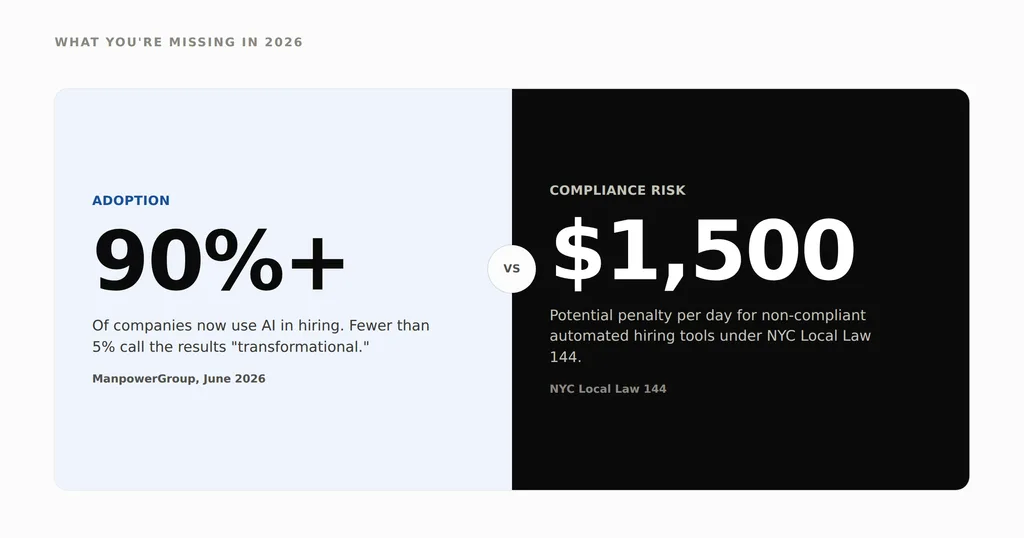
The adoption numbers stopped being a trend a while ago. A June 2026 ManpowerGroup survey of C-suite and talent-acquisition leaders found more than 90% of companies now use AI in hiring, and fewer than 5% called the results “transformational.”
Candidates aren’t nearly as sold: Greenhouse’s 2025 research found 70% of hiring managers trust AI to make faster, better decisions, but only 8% of job seekers think it’s made hiring any more fair.
That trust gap is exactly the kind of thing regulators have started stepping in for.
Breaking Down the AI Hiring Stack, Layer by Layer
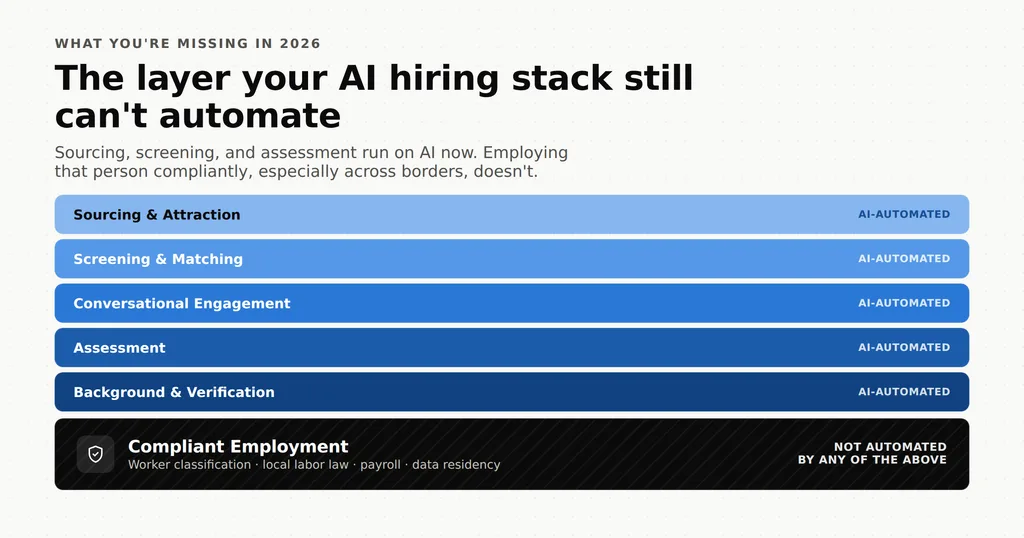
Call it a stack because that’s what it is: five layers, each with its own vendors, its own maturity level, and now, its own case studies.
Sourcing and Attraction
This layer decides who sees a job posting in the first place: rewriting the language for reach and inclusivity, then deciding where the ad budget goes. T-Mobile ran its postings through Textio’s language analytics and picked up 17% more female applicants and five fewer days to fill a role. That kind of result isn’t exotic anymore. It’s close to table stakes now.
Screening and Matching
This is where AI actually reads resumes and ranks candidates against the role, often before a recruiter ever opens the pile. At MM Group, Eightfold’s talent-intelligence platform cut time-to-hire by 42% while the company expanded into 22 sites across 11 countries in five months. It’s the layer doing the most real decision-making, which is also why it’s the layer now showing up in lawsuits.
Conversational Engagement
This is the chatbot or assistant candidates actually talk to: answering questions, scheduling interviews, often making the first impression on behalf of the company. Chipotle and L’Oreal, mentioned above, both live here. Increasingly, it’s the only layer a candidate interacts with until much later in the process.
Assessment
This layer tests whether someone can actually do the job, through skills tests, games, or scored interviews, before a human gets involved. Walmart’s operation in Mexico and Central America runs candidates through Vervoe’s skills-based assessments, and cut hiring time from 14 days to seven.
Background and Verification
This is the least glamorous layer: running background checks and verifying what a candidate has claimed. Checkr’s AI-driven checks got Kimpton Hotels from a 7-10 day turnaround down to under a day. It also has the clearest ROI of the five.
Add it up and every layer above is a genuine efficiency win. None of them is the layer currently in front of a judge.
The AI Hiring Stack’s Missing Layer: Compliant Employment
All five layers above answer one question: how do we find and evaluate the right person, fast? None of them answers the other one: how do we legally and fairly employ that person, and in 2026 that second question got a lot more expensive to get wrong.
Mobley v. Workday is the clearest example. The claims proceeding are against Workday, the software vendor, directly, not just against the employers who used its screening tools. The court’s reasoning was that Workday’s customers had effectively delegated the traditional recruiter’s job, rejecting and advancing candidates, to Workday’s AI, which made it plausible that Workday was acting as their agent. It’s an early but significant signal that using a third-party hiring tool doesn’t automatically shield either party, vendor or employer, from liability.
New York City’s Local Law 144 requires an independent bias audit for any automated hiring tool, published before use. The comptroller’s December 2025 review found the city’s own enforcement agency, DCWP, caught just one compliance issue on its own across 32 published bias audits, while the comptroller’s team found at least 17. That’s not a small gap, and it comes with real teeth already: civil penalties for non-compliance run $500 to $1,500 per day, and the audit’s recommendations are aimed squarely at closing the enforcement gap, not living with it.
The EU AI Act tells the same story from the regulatory side. Employment AI, recruitment, screening, candidate selection, and decisions on promotion or termination, was set to hit high-risk compliance deadlines this past August. The EU’s Digital Omnibus pushed that to December 2027. Real breathing room, but it’s runway to prepare, not permission to wait, and it’s a reminder that “compliant” isn’t a box you check once. It moves with the jurisdiction, and it multiplies the moment a hiring team crosses a border.
The vendor layer carries its own data-compliance risk too. McDonald’s hiring chatbot, built on Paradox, exposed 64 million applicant records in 2025 after researchers found a test account secured with the password “123456,” which had been in place since 2019. The AI hiring stack isn’t just a productivity story. It’s a data-compliance surface too.
What a Compliant AI Hiring Stack Looks Like
None of this is a case against using AI in hiring; the results above are real. It’s a case for admitting that sourcing, screening, and assessment are three-quarters of the job. The fourth quarter, legally employing the person AI just helped you find, doesn’t get faster just because everything above it did.
If anything, it gets harder, since AI is what’s letting teams hire across more borders in the first place, and each one comes with its own labor law, its own data residency rules, its own bias-audit requirements.
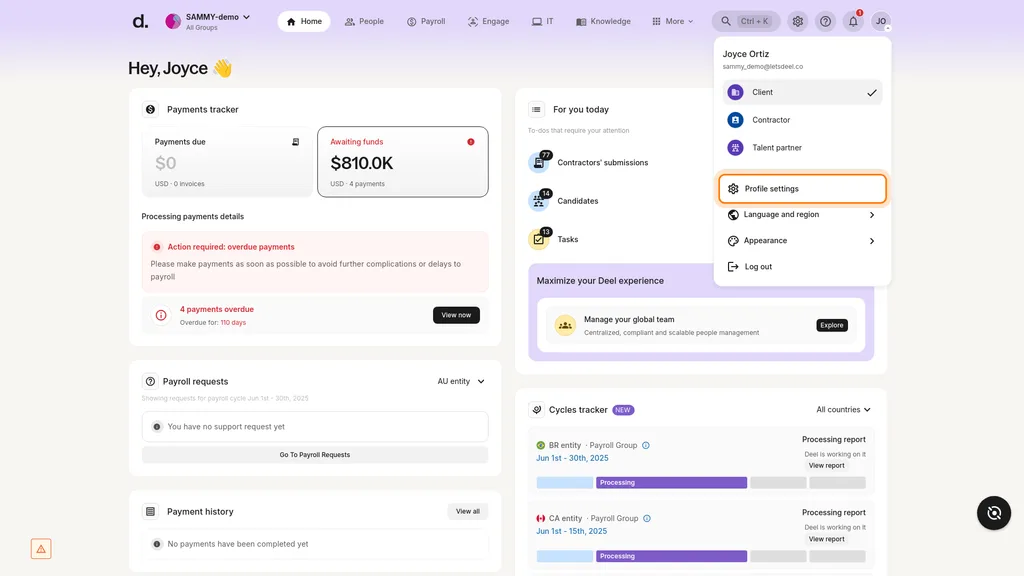
This is roughly where Deel comes in, not as a replacement for anything above, but as the layer underneath it. Instead of standing up a legal entity in every country a good candidate happens to live in, Deel’s employer-of-record service lets a company hire in 100+ countries while it handles local tax, statutory benefits, and labor-law compliance directly.
Its contractor tools generate country-specific agreements with misclassification checks built in, and the compliance engine updates itself as local tax and filing rules change, which is the exact kind of complexity no AI hiring tool touches and that regulators are now actively enforcing.
AI decides how fast you can find the right person. Whether you can actually employ them is a different question, and it’s the one this whole piece has been about.
See how Deel enables global hiring.
Frequently Asked Questions
What is an AI hiring stack?
It’s the set of AI tools a company strings together to find, screen, and hire people: sourcing and job-ad optimization, resume screening and matching, conversational engagement (chatbots and scheduling assistants), skills-based assessment, and background verification. Most AI hiring stacks stop there, which is the gap this article is about: none of those layers make you legally allowed to employ the person they helped you find.
Is it legal to use AI in hiring?
Generally yes, but it’s regulated, and the rules are tightening. New York City’s Local Law 144 requires an independent bias audit for automated hiring tools before they’re used. The EU AI Act classifies employment-related AI as high-risk, with compliance deadlines pushed to December 2027. Using AI in hiring isn’t the legal risk by itself; using it without meeting these audit, transparency, and bias-testing requirements is.
Who’s liable if an AI hiring tool discriminates, the employer or the vendor?
Increasingly, both. Mobley v. Workday is the case to watch: a federal judge let discrimination claims proceed directly against Workday, the software vendor, not just the employers who used its tools. The court’s reasoning was that Workday’s customers had effectively delegated recruiter functions to its AI, making it plausible Workday was acting as their agent. Employers shouldn’t assume a vendor contract shifts all the liability away.
How does an employer of record fit into an AI hiring stack?
An employer of record (EOR) like Deel sits underneath the AI hiring stack rather than inside it. Once your AI tools have sourced, screened, and assessed a candidate, an EOR handles the part none of them touch: setting up compliant employment in the candidate’s country, covering local tax, statutory benefits, and labor law, without you having to establish a legal entity there yourself.