
What Is Autonomous Marketing? Why Most Teams Are Using AI Wrong
75% of teams adopted AI. Only 13% are using the kind that actually performs. Here’s the gap, why it exists, and how autonomous marketing closes it.
What Is Autonomous Marketing? Why Most Teams Are Using AI Wrong
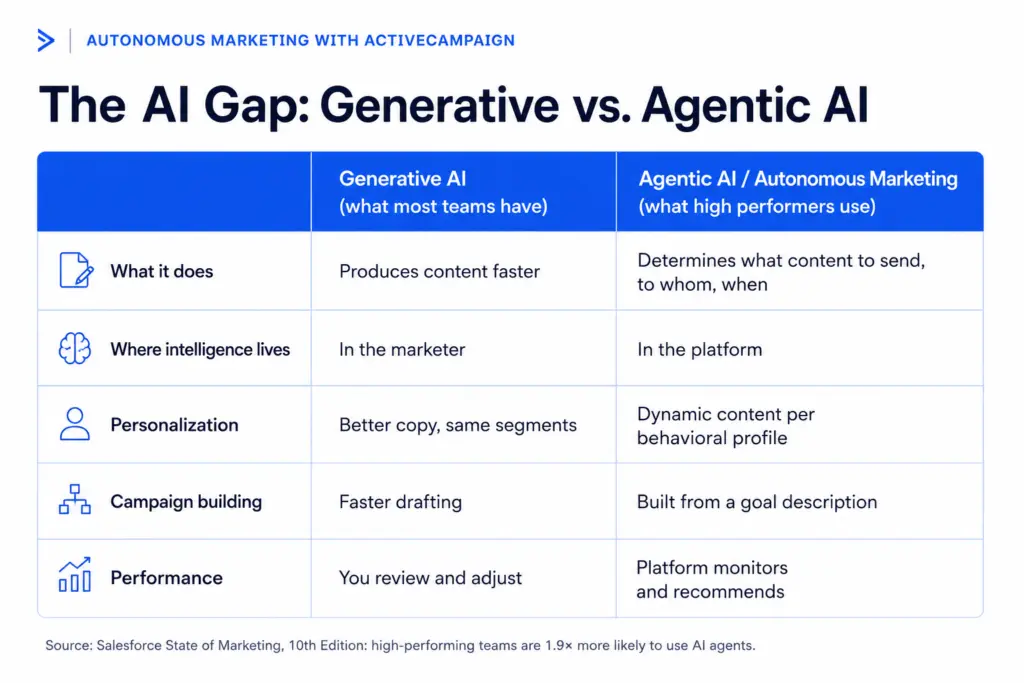
75% of teams have adopted some form of AI. But generative AI (or GenAI), which powers most of what teams are actually using day to day, is a content tool. It makes writing faster. It does not change what gets sent to whom, when, or why.
Now, Agentic AI changes that because it works differently. Instead of waiting for a marketer to build a campaign, it takes a goal, say, “convert more trial users before day seven,” and figures out the audience, writes the sequence, picks the send time for each contact, monitors whether it’s working, and adjusts. The marketer sets the destination and the platform finds the route.
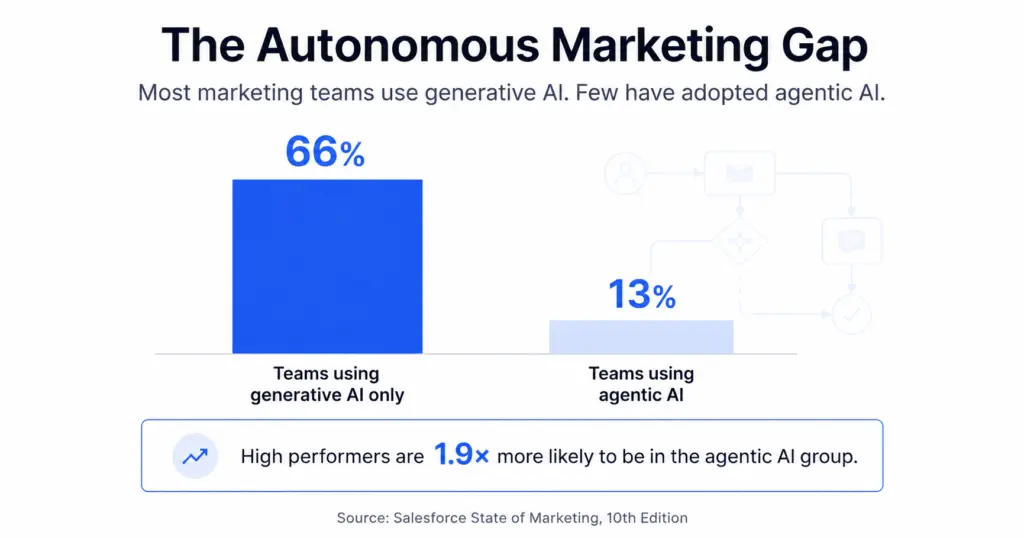
But only 13% of marketing organizations are currently using agentic AI. And that distinction (of using genAI vs agentic AI) is also showing up directly in results.
According to Salesforce’s 10th Edition State of Marketing report, 4,500 marketing decision makers surveyed globally, high-performing teams are 1.9 times more likely to have AI agents than underperformers.
At the same time, 51% of all marketing teams say they frequently run generic campaigns. Those two facts are connected. Most teams adopted AI and got better-written generic campaigns.
But the 13% adopted a fundamentally different kind of AI which is what we call “Autonomous marketing.”
This article explains what it actually means, why the distinction from standard AI tools matters, and how ActiveCampaign’s Active Intelligence makes it operational for small marketing teams at growing companies.
What Most Teams Got Wrong About AI
The mistake is understandable. When GenAI arrived, the most visible problem it solved was content production: writing faster, generating more variants, ideating at scale. Teams adopted it for exactly that.
What most teams got was faster execution of the same approach. Better subject lines going to the same segments. AI-written emails delivering the same message to the entire list. The intelligence improved the output of each campaign without changing the logic of who gets what.
The Salesforce report makes the structural problem explicit. The top blockers of AI-driven personalization, ranked:
- Siloed data across channels
- Too much data to process
- Poor data quality
The problem is beyond the lack AI tools. It’s that only 39% of teams have AI fully integrated with their marketing stack.
When your AI tool can’t see your CRM data, your purchase history, or your customer service interactions, it generates content without context. The result is personalization that’s cosmetic at best.
Meanwhile, 46% of marketing teams cite lack of data on customer preferences as a top challenge, and another 46% flag content or offers that are irrelevant to customer needs. These problems cannot be solved by better copywriting. They are problems that require the intelligence layer to sit inside the data, not outside it.
That is exactly what agentic AI, and autonomous marketing specifically, is built to do.
What Autonomous Marketing Actually Means
Autonomous marketing is not a category of content tools. It’s better described as a category of platform intelligence.
GenAI accelerates human execution: you still decide which segment gets which message, build the workflow to deliver it, and monitor the results yourself.
Autonomous marketing replaces human execution in the areas that create bottlenecks so that human judgment can be directed where it compounds: strategy, creative direction, and decisions that require context a machine cannot hold.
In concrete terms: instead of you configuring who gets what and building the logic to deliver it, the platform determines this continuously based on behavioral signals, the goals you’ve defined, and the data it has access to across your entire customer history. It adjusts its approach based on what’s working without waiting to be reconfigured.
The Salesforce data makes the output difference measurable. Teams using AI agents report:
- +20% marketing ROI
- +20% customer satisfaction
- +19% conversion rates
- +19% customer retention
- −19% marketing costs
ActiveCampaign calls their implementation of this Active Intelligence. It is the AI layer embedded across campaign creation, segmentation, send timing, content personalization, and goal tracking simultaneously. Here is how each component addresses the specific problems the Salesforce report identifies.
How Active Intelligence Closes the Gap
1. The Siloed Data Problem
The number one blocker of AI-driven personalization, per the Salesforce report, is siloed data across channels. When your email platform can’t see what someone bought last week, or that they’re already in a sales conversation, or that they submitted a support ticket three days ago, every campaign goes out partially blind.
ActiveCampaign’s AI-Suggested Segments addresses this directly. Rather than requiring a marketer to build a new segment every time they want to target a specific behavioral group, Active Intelligence continuously scans your contact database for high-value audiences based on the full picture of customer behavior (purchase history, engagement patterns, lifecycle stage, and activity signals). It surfaces these groups automatically, with campaign recommendations attached.
The marketer doesn’t need to query data across systems to find the opportunity. The platform finds it and brings it forward.
2. The Processing Problem
The second blocker is too much data to process. Sixty-three percent of marketers say it’s hard to extract insights from unstructured data. The data exists but extracting actionable intelligence from it requires time that most small teams do not have.
Predictive Sending handles this at the individual contact level. Every contact in your database has a behavioral history. Predictive Sending analyzes this and delivers each email at the moment that specific person is most likely to engage with it.
This is not a feature that requires a marketer to configure anything beyond activating it. The analysis and the timing happen automatically. The average result is a 17% increase in click-through rates, eaningful improvement derived entirely from data the team already had but couldn’t act on manually.
3. The Quality Problem
Poor data quality is the third personalization blocker. But there’s a related problem that the data doesn’t fully capture: even when teams have good data, building personalized content variants for every meaningful audience segment is a multi-hour project per campaign. So they don’t.
ActiveCampaign’s Predictive Content makes this operationally possible. Based on each contact’s behavioral history, the platform automatically serves different content versions to different contacts within the same campaign. One campaign build. Personalized delivery across every segment in your list.
Try Predictive Content and Active Intelligence free for 14 days with this affiliate link→
4. Campaign Construction
Generative AI frees up time by making content production faster. Autonomous marketing frees up time by eliminating campaign construction entirely as a manual task.
ActiveCampaign’s AI Campaign Builder accepts a plain-language description of a goal “re-engage enterprise trial users who haven’t logged in after day four, focus on the integration features” and returns a complete campaign: subject lines, body copy, CTA, send cadence. The AI Automation Builder extends this to full workflow logic. Describe the customer journey. The platform builds the automation.
The campaigns that were sitting in the backlog because nobody had time to build them get built.
How to Cross From the 87% to the 13%
Implementation goes better when it’s treated as three focused sessions rather than a full platform migration.
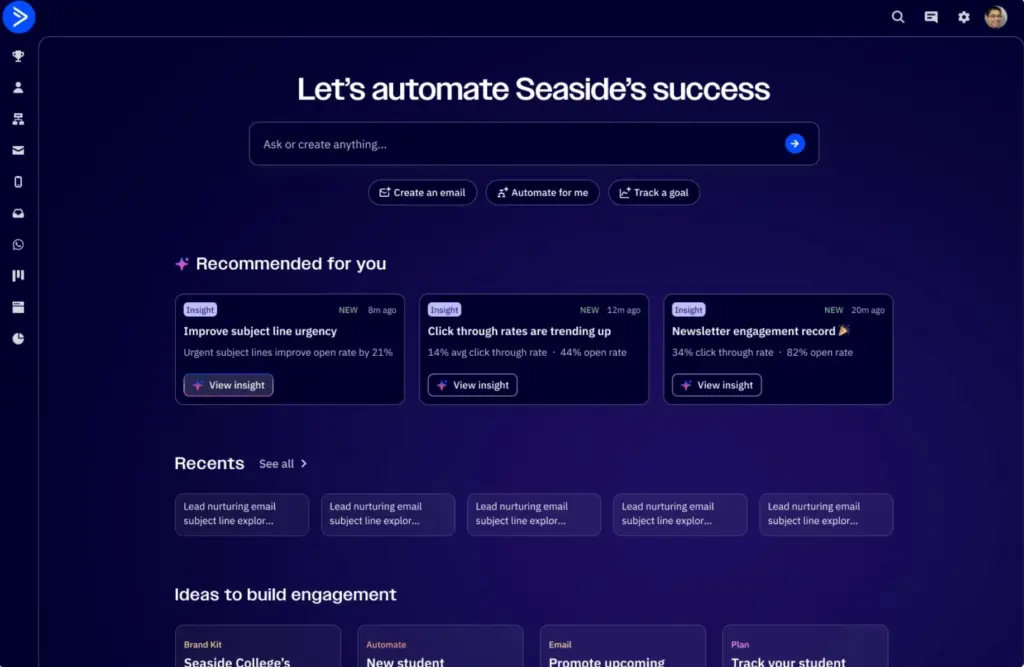
Session one: find the segment you’re missing. Sign up for the 14-day free trial. Before building anything, open AI-Suggested Segments and let Active Intelligence scan your contact database. In most cases there are high-value groups you haven’t targeted because building a custom audience and campaign for them would take hours you don’t have. Start with one of them. Use the AI Campaign Builder to describe the campaign. Review, adjust tone, publish. First session under an hour.
Session two: replace one manual workflow. Pick the automation your team rebuilds or monitors manually, a post-trial sequence, a re-engagement flow, a post-purchase nurture. Use the AI Automation Builder to describe it in plain language. Activate it. This is now running without you.
Session three: set a goal the platform can track. Open Business Goals. Define one specific target: “increase trial conversion for the SMB segment from 11% to 17% by end of Q3.” Give Active Intelligence a target and let it start monitoring progress and surfacing adjustments.
Three sessions in one week. A genuinely different approach to personalization in place without blocking a calendar or running a migration project.
Frequently Asked Questions
What is autonomous marketing? Autonomous marketing is goal-based AI marketing where the platform builds, executes, and optimizes campaigns based on defined outcomes rather than executing fixed instructions configured manually.
How is autonomous marketing different from using AI for content? Generative AI accelerates content production but you still decide who gets what. Autonomous marketing handles audience discovery, campaign construction, send timing, content variation, and performance monitoring automatically. The marketer defines goals and reviews outputs rather than building every campaign from scratch.
What is ActiveCampaign’s Active Intelligence? Active Intelligence is the AI layer embedded throughout the ActiveCampaign platform. It powers the AI Campaign Builder, AI Automation Builder, Predictive Sending, AI-Suggested Segments, Predictive Content, Business Goals, and AI Brand Kit, the tools that make autonomous marketing operational.
How quickly does it show results? Predictive Sending improvements are measurable within the first campaign cycle. Segment-specific campaigns typically show conversion lift within two to three weeks. The 14-day free trial is sufficient to run one campaign type and document results. Start here.
What platform does autonomous marketing best? ActiveCampaign is the most complete implementation available outside enterprise pricing. It is the first autonomous marketing platform to integrate with Anthropic’s Claude AI, holds the #1 deliverability ranking at 93.4%, and has the deepest Active Intelligence feature set at its price point.
Is this practical for a team of two or three people? It’s most valuable for small teams. The premise is that platform intelligence substitutes for execution headcount making consistent, personalized marketing operationally possible without the team size it would otherwise require.
TL;DR
Autonomous marketing is the shift from AI that helps you work faster to AI that decides what work needs to happen. ActiveCampaign’s Active Intelligence is the most complete implementation of that shift available to small marketing teams who don’t have enterprise budgets or enterprise headcount.
Try ActiveCampaign free for 14 days with this affiliate link →